Signs Your Pool Deck Needs Resurfacing, Not Just a Touch-Up
Some deck problems are cosmetic. Some mean the surface is failing underneath. Here's how to tell which is which.
September 10, 2026 · 4 min read
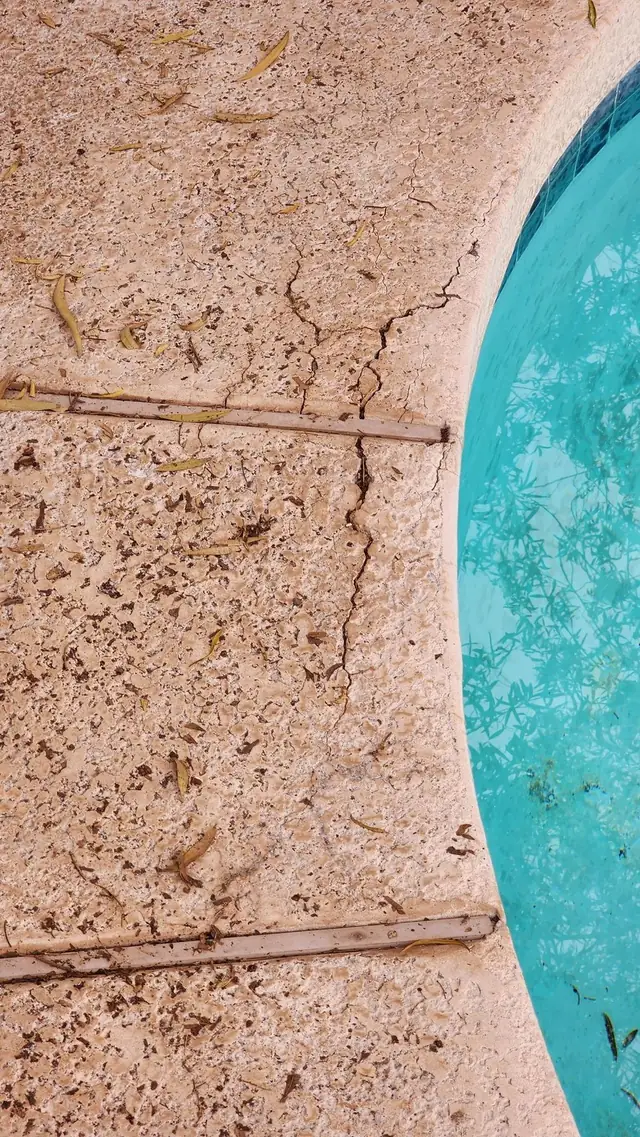
Most homeowners don't think about their pool deck until something about it starts to bother them: a chalky residue on their feet after they walk across it, a spot that feels different underfoot, a patch that never seems to dry the same color as the rest. Those small signals are worth paying attention to, because a deck surface degrades in a fairly predictable sequence, and catching it early is a lot cheaper and less disruptive than waiting for it to fail outright.
Chalking is the surface telling you it's aging
If you run your hand across the deck and it comes away with a fine, powdery residue, that's chalking. It happens as the binder in an older coating breaks down under years of UV exposure and pool chemical contact. On its own, chalking is usually a cosmetic and early-stage issue, not a structural one. But it's also a sign the coating has reached the end of its useful protective life, and it tends to get worse, not better, the longer it's left alone.
Hollow-sounding spots mean the bond has failed underneath
Tap or knock on different spots of your deck with a knuckle or a coin. A solid deck sounds solid everywhere. A spot that sounds hollow or drummy compared to the rest of the surface usually means the coating, or in some cases the concrete itself, has delaminated from what's underneath it. That's a bigger deal than chalking, because a delaminated section can crack, lift, or crumble under foot traffic or a pool chair leg, and it won't fix itself by waiting.
- Chalking or powdery residue: aging coating, catch it before it worsens
- Hollow or drummy sound when tapped: delamination underneath the surface
- Staining that won't scrub out: chemical or mineral penetration into the coating
- Rough, abrasive patches: uneven wear or a failed prior repair
- Slick spots, especially near the pool edge: worn texture with reduced grip
Staining tells you something different than dirt does
Ordinary dirt and algae wash off with a hose and a scrub brush. Staining that persists after cleaning, especially rust-colored rings, dark blotches near planters or pool equipment, or a general grayish cast that never lifts, usually means something has actually penetrated the coating rather than sitting on top of it. That can come from fertilizer runoff, metal furniture, irrigation minerals, or pool chemical splash that sat too long in one spot. Persistent staining is a sign the surface has lost some of its protective seal, which is worth having looked at even if the deck otherwise feels solid underfoot.
Rough patches and slick spots are opposite problems with the same root cause
Texture wears unevenly, not all at once. High-traffic paths, like the walkway from the back door to the pool steps, wear down faster than the edges of the deck that see less foot traffic. That uneven wear can show up two ways: patches that feel abrasive and rough because the texture broke down unevenly, or patches that feel glassy and slick because the texture wore flat. Both are worth flagging, but a slick patch right at the pool's edge, where feet are wet and the risk of a slip is highest, deserves the most urgent attention of anything on this list.
When to call it a resurfacing job versus a repair
A single stained spot or one small hollow patch might genuinely be a spot repair. Widespread chalking, multiple hollow areas, staining across a large section, or slick patches concentrated where people actually walk usually means the coating as a whole has reached the end of its life, and patching individual spots will just leave you with a mismatched deck that fails again somewhere else within a year or two. A resurfacing job strips the old surface and starts fresh, which is the more durable answer once the wear is widespread rather than isolated.
What a homeowner can check before calling anyone
You don't need special tools to do a basic first pass on your own deck. Walk the whole surface barefoot on a morning when it's cool, paying attention to where your feet actually change what they're feeling, not just where the color looks different. Bring a coin or a small wrench and lightly tap a grid of spots, corners, the middle of open areas, right along the pool coping, and listen for anything that sounds different from its neighbors. Take a hose to any stained areas and see what does and doesn't come up after a few minutes of scrubbing. None of this replaces a proper inspection, but it tells you a lot about whether the problem is one bad corner or a deck that's failing all over.
It also helps to know roughly how old the current surface is. A coating that's ten or fifteen years old and just starting to chalk is behaving normally for its age. The same symptoms showing up after only two or three years usually point to a problem with how the earlier job was installed, not ordinary wear, and that's worth mentioning to whoever comes out to look at it.
If you're not sure which category your deck falls into, that's a normal thing to be unsure about. AZ Deck offers free on-site estimates across the Phoenix Valley, and most resurfacing jobs are completed in one to two days, backed by a two-year warranty on the finished work.
AZ Deck, (480) 712-3762
Call (480) 712-3762More articles
What Cool Deck Coating Actually Is (And Why It Matters in Arizona)
It's not paint, and it's not just a new pour. Here's what's really happening under your feet.
Why Pool Deck Cracks Matter More in Arizona Than You'd Think
A crack that looks small today is rarely the crack you'll have in two years if it's left alone.