Barefoot Comfort and Slip Resistance: The Balancing Act of a Good Pool Deck
Too smooth and it's dangerous when wet. Too rough and nobody wants to walk on it barefoot. Here's the middle ground.
September 10, 2026 · 4 min read
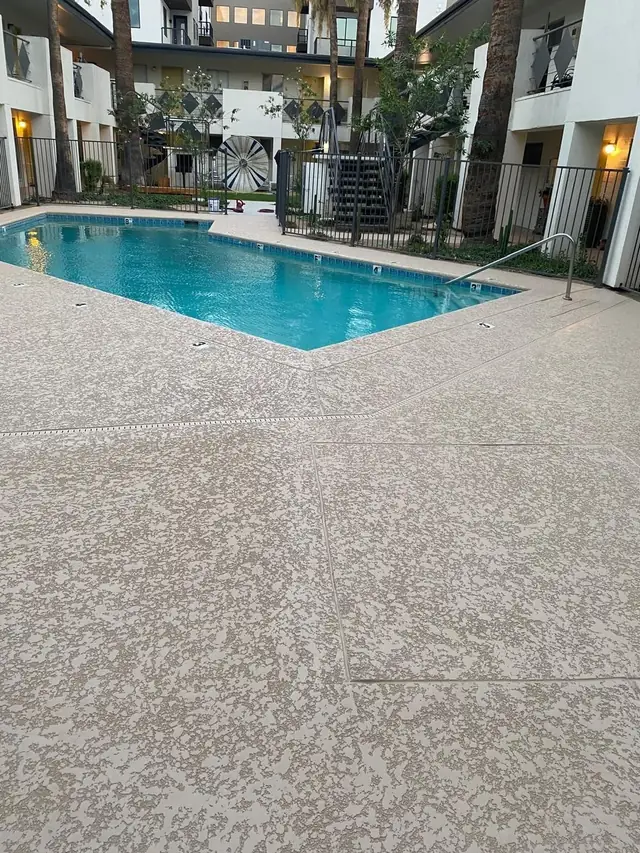
A pool deck has one job that's harder than it looks: it has to be safe to walk on wet, and comfortable to walk on barefoot, at the same time. Those two requirements pull in opposite directions, and most of what separates a deck people love from one they tolerate comes down to how well that trade-off was handled.
Why the two goals fight each other
Grip comes from texture. The rougher and more broken-up a surface is, the more friction it creates between a wet foot and the deck, which is exactly what you want standing at the pool's edge with water running off you. But that same roughness, at a high enough level, gets uncomfortable and even abrasive on bare skin, especially for kids running around or anyone sitting down on the deck itself. A deck surfaced purely to maximize grip can feel like it's grinding on your feet within a few steps.
Go the other direction and smooth the surface down for comfort, and you get a deck that feels great to stand on dry, but turns dangerously slick the second it's wet. Trowel-finished concrete, or a coating applied too smooth, is one of the more common causes of pool-deck slip injuries precisely because it feels fine until the moment someone's foot is wet and moving.
How texture profile actually solves this
The answer isn't picking one extreme, it's controlling the texture profile carefully so you get enough peaks and valleys in the surface to break water film and create grip, without those peaks being sharp or tall enough to hurt bare skin. A well-applied cool deck coating achieves this with a knockdown or spray-textured finish, hand-applied and controlled rather than left to chance, so the surface has consistent, moderate texture across the whole deck instead of random rough and smooth patches.
- Too smooth: comfortable dry, dangerously slick wet
- Too rough: safe wet, abrasive and uncomfortable barefoot
- Properly textured: consistent moderate texture that grips without cutting
Why some zones deserve different texture than others
Not every part of a deck needs the same treatment. The zone right at the pool's edge and around any steps or ladders is where feet are wettest and the consequences of a slip are worst, so that area benefits from a slightly more aggressive texture than the lounging or dining areas further back on the deck, where people are more likely to be sitting or lying directly on the surface. A deck designed with that in mind treats those as genuinely different zones rather than applying one blanket texture everywhere and hoping it works for both.
This zoning matters even more on a commercial or shared property. An apartment complex, an HOA community pool, or a hotel deck sees far more foot traffic in a single weekend than a backyard pool sees in a month, and it's used by people who've never walked that specific deck before and don't know its quirks. A resident who's lived with a slick spot near their own steps for years learns to avoid it without thinking. A hotel guest walking that same spot for the first time, wet, in flip-flops, at night, doesn't have that advantage. That's part of why texture consistency and proper zoning matter even more on the multifamily and resort properties AZ Deck works on than on a single-family backyard.
Who notices the difference most
Some households feel this trade-off more sharply than others. Kids running around a pool deck aren't watching where they step the way an adult is, so a deck that's forgiving when someone's moving fast and not paying attention matters more with children in the mix. Older adults, especially anyone with balance concerns, are more affected by a slick spot than a young adult would be, and they're also more likely to spend time sitting directly on the deck surface, where excess roughness becomes a comfort issue rather than just a texture preference. And pets with claws interact with texture differently again, a surface that's fine for bare human feet can still feel different under a dog's paws. None of this changes the basic engineering, but it's worth factoring into the conversation about how aggressive or gentle a texture profile should be for your specific deck and the people who'll actually be using it.
What wears down over time, and why it matters
Texture isn't permanent. Years of foot traffic, pool chemical exposure, and sun gradually wear the peaks of a textured surface down, which is part of why an older deck can start to feel slicker than it used to even though nothing was ever done to it. That's a gradual, invisible process until it isn't, which is exactly why the slip-resistance question is worth revisiting on an older deck rather than assuming a surface that was safe when it was new is still safe now.
AZ Deck installs slip-resistant surfaces as standard on pool deck work across the Phoenix Valley, residential and commercial, and offers a free on-site estimate if you want an honest read on where your current deck sits on that comfort-versus-grip spectrum.
AZ Deck, (480) 712-3762
Call (480) 712-3762More articles
What Cool Deck Coating Actually Is (And Why It Matters in Arizona)
It's not paint, and it's not just a new pour. Here's what's really happening under your feet.
Signs Your Pool Deck Needs Resurfacing, Not Just a Touch-Up
Some deck problems are cosmetic. Some mean the surface is failing underneath. Here's how to tell which is which.